



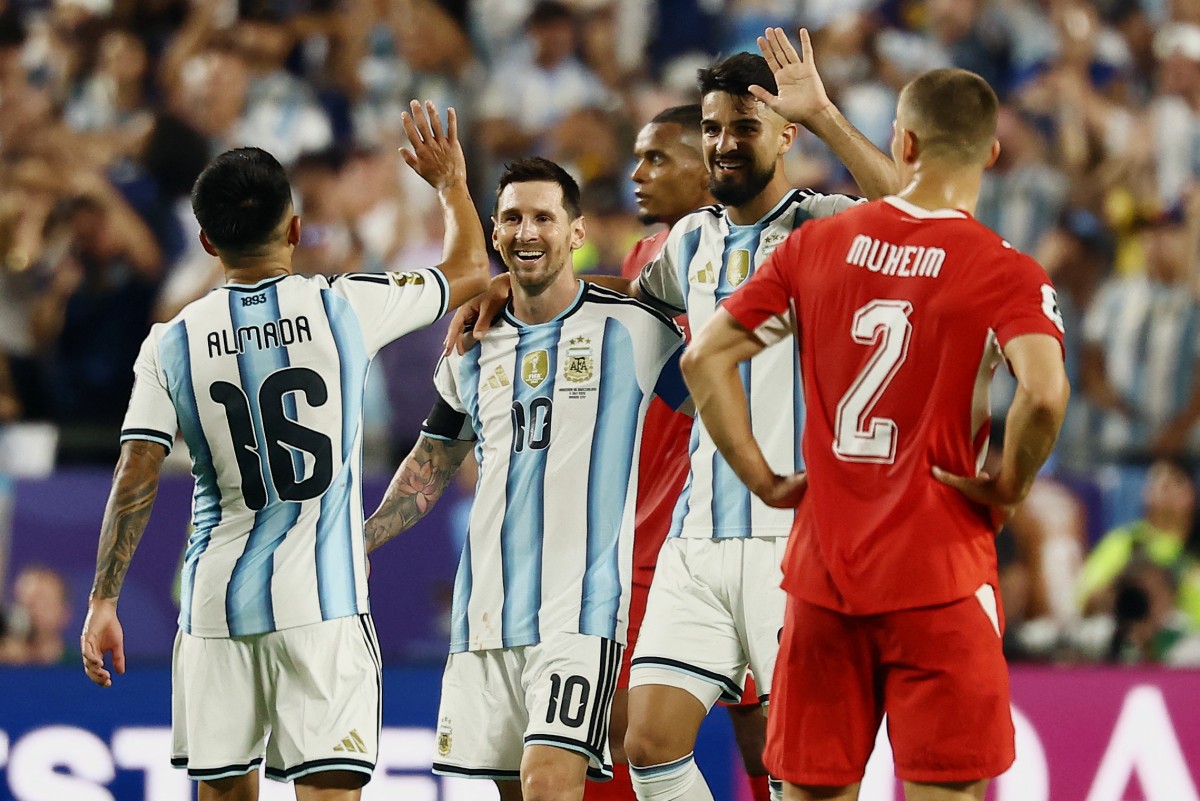
Lionel Messi’s outstanding performances have helped Argentina reach a blockbuster World Cup semi-final against England in Atlanta on Wednesday, but the defending champions’ campaign has also been surrounded by a wave of online conspiracy theories alleging that favourable decisions have helped them progress.
The claims, which have spread widely across social media platforms, suggest without evidence that refereeing decisions and tournament structures have been designed to benefit Argentina and keep Messi’s title defence alive.
Artificial intelligence-generated videos, edited images and viral memes have amplified the accusations, including manipulated images showing FIFA President Gianni Infantino and Messi in fictional scenes or placing Infantino’s face inside the Sun of May symbol on Argentina’s national flag.
While FIFA has not found evidence supporting claims of unfair treatment, several controversial moments involving video assistant refereeing (VAR), disciplinary decisions and match officials have fuelled debate among fans and commentators.
One of the earliest incidents cited by critics occurred during Argentina’s group-stage victory over Algeria.
With Argentina leading 1-0, Messi appeared to make contact with Algeria captain Aissa Mandi’s right calf and Achilles area after a challenge in the 30th minute.
Polish referee Szymon Marciniak awarded Algeria a free-kick but did not issue a yellow or red card to Messi, who later scored a hat-trick in the match.
Several former players and analysts argued that the challenge could have been considered serious foul play under football regulations and deserved a straight red card.
Former Manchester City defender Nedum Onuoha said he believed Messi should have been sent off, while former Bundesliga referee Patrick Ittrich also argued that similar incidents had resulted in red cards in other competitions.
Algeria’s football federation later submitted an official complaint to FIFA, describing the refereeing during the match as unfair.
However, no disciplinary action was taken against Messi, allowing him to continue Argentina’s World Cup campaign.
Another major controversy emerged during Argentina’s dramatic last-16 victory over Egypt.
Argentina produced a remarkable comeback, recovering from a 2-0 deficit to win 3-2 and advance to the quarter-finals.
However, Egyptian players and coaching staff criticised several refereeing decisions, particularly a VAR intervention that ruled out an Egypt goal.
The goal was disallowed after VAR identified a foul on an Argentina player earlier in the move, even though the incident occurred several phases before Mostafa Zico scored at the opposite end of the pitch.
Former FIFA referee Mark Clattenburg questioned whether VAR had gone too far by reviewing an earlier incident that did not appear directly connected to the goal-scoring action.
Egypt coach Hossam Hassan also suggested that Argentina may have benefited from external factors.
“There seems to have been pressure on the Argentinian side on the referee that has brought about this outcome,” Hassan said.
However, FIFA refereeing chief Pierluigi Collina dismissed the allegations as unfounded and defended the use of VAR technology.
Argentina’s quarter-final victory over Switzerland also became part of the controversy surrounding the team’s World Cup campaign.
During the match, Switzerland had equalised 1-1 and were pushing for control when Argentina midfielder Leandro Paredes was initially shown a yellow card for a challenge on Breel Embolo.
A VAR review later determined that Embolo had simulated the incident, leading to the reversal of the original decision.
Because Embolo had already received a yellow card, he was shown a red card, leaving Switzerland with 10 players.
Argentina eventually won the match 3-1 after extra time.
Swiss coach Murat Yakin criticised the decision, saying his team had been punished by a rule he considered unacceptable.
However, several commentators defended the decision, arguing that Embolo had clearly attempted to deceive the referee.
USA Today columnist Nancy Armour rejected claims of World Cup manipulation, saying critics would need stronger evidence than disputed refereeing calls to prove allegations of a conspiracy.
Critics have also pointed to Argentina’s route to the semi-finals as evidence of preferential treatment, arguing that the team avoided many of the tournament’s strongest opponents.
Argentina’s opponents before facing England included Algeria, Jordan, Austria, Cape Verde, Egypt and Switzerland.
The team has not faced an opponent ranked higher than 19th in the world before the semi-final.
However, supporters of the tournament format argue that the situation is largely the result of FIFA’s seeding system, which places the highest-ranked teams in different sections of the draw to prevent early meetings between major contenders.
England have also avoided a top-10 ranked opponent before the semi-finals, while France faced seventh-ranked Morocco in the quarter-finals.
Spain have had the most difficult route among the remaining teams, defeating Portugal and Belgium, ranked fifth and ninth respectively.
As Argentina prepare to face England, the focus remains on Messi’s pursuit of another World Cup triumph, but the debate over refereeing decisions and tournament fairness is likely to continue throughout the final stages of the competition.
AFP