
















At least one million women and girls have lost access to essential support services due to major reductions in foreign aid funding since January 2025, the United Nations has warned.

The UN Women agency said the cuts have placed women-led organisations and women’s rights groups under severe pressure, threatening services that provide protection, healthcare, education support and assistance to survivors of violence in some of the world’s most vulnerable communities.
The warning comes as humanitarian needs continue to rise globally, with armed conflicts, displacement and economic pressures affecting millions of people. UN Women said around 120 million women and girls currently require humanitarian assistance and protection, particularly in regions affected by war and instability.
In a new report based on responses from 855 women-led and women’s rights organisations operating across 52 crisis-affected countries, the agency said many groups are struggling to survive because of declining international funding.
The report found that 84 percent of organisations surveyed had experienced increased demand for their services since January 2025, while nearly nine in 10 said they could no longer meet the level of need facing their communities.
Two out of every five organisations surveyed said they expected to shut down either temporarily or permanently within the next year if funding shortages continued.
Sofia Calltorp, UN Women’s head of humanitarian action, said the organisations facing closure were providing vital services during some of the world’s most serious crises.
“The women’s organisations at risk of being shut down are on the frontlines of the world’s most severe humanitarian crises,” Calltorp said.
She warned that reductions in funding were directly affecting survivors of conflict-related sexual violence, displaced women, girls forced out of school and communities struggling with food insecurity and instability.
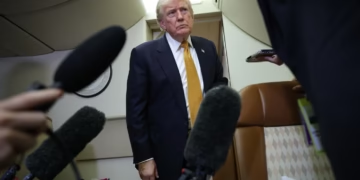
The funding crisis follows a broader reduction in foreign aid commitments by several major donor countries. US President Donald Trump moved to cut foreign aid spending after returning to office in 2025, while other international donors have also reduced their assistance budgets amid domestic economic pressures.
UN Women said the impact of these cuts was particularly severe because women’s organisations often serve as the first point of contact for vulnerable populations during emergencies.
The agency reported that many organisations have continued operating only because staff members are working without pay. About 65 percent of women-led organisations surveyed said employees were providing unpaid labour to maintain essential services.
Nearly half of the organisations also reported increased staff burnout as workers attempt to respond to growing humanitarian needs with fewer resources.
The UN agency also raised concerns over the impact on efforts to combat gender-based violence.
According to the report, 86 percent of women’s organisations reported an increase in gender-based violence in the communities they serve. UN Women said conflict-related sexual violence doubled in 2025, at a time when support systems for survivors were already weakening.
The organisation warned that the consequences of reduced funding could be felt in everyday situations.
A survivor of domestic violence could arrive at a shelter that has closed because of funding shortages. A pregnant woman in a conflict zone could face longer journeys to reach healthcare services, while families struggling with poverty could lose access to assistance that helps provide food and protection.
Beyond immediate humanitarian concerns, UN Women said the decline in support for women’s organisations was also affecting progress on gender equality and women’s participation in public life.
The agency said one in five organisations surveyed had already suspended programmes aimed at advancing women’s leadership and gender equality.
More than half reported seeing a decline in women’s participation in community leadership and local decision-making processes.
UN Women described the funding crisis as part of a wider global challenge affecting women’s rights.
READ MORE: IMF Cuts 2026 Global Growth Forecast Amid Middle East War
“The dismantling of women’s organisations is not happening in a vacuum but against a global backlash on the rights of women and girls,” the agency said.
Humanitarian groups have repeatedly warned that funding shortages are creating gaps in emergency responses, particularly in conflict zones where local organisations often provide essential services that international agencies cannot easily deliver.
The UN said continued investment in women-led organisations remains critical to protecting vulnerable communities and ensuring that women and girls affected by crises are not left without support.
As humanitarian emergencies continue to expand across several regions, the agency warned that further reductions in aid could deepen existing inequalities and leave millions of women and girls facing greater risks.
AFP