
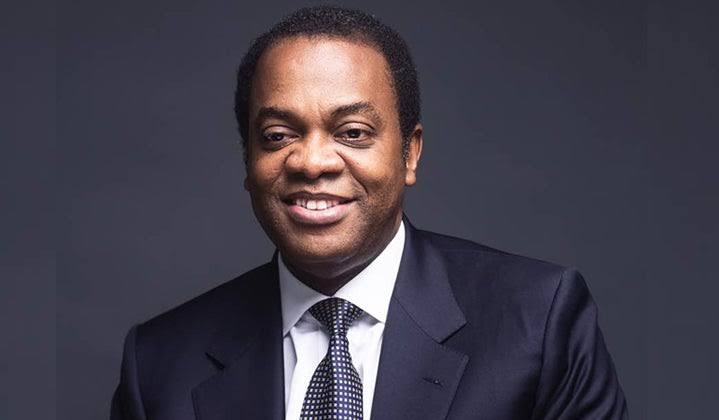
Former Cross River State Governor Donald Duke has recounted how former military Head of State Ibrahim Babangida allegedly warned former President Olusegun Obasanjo against trusting his then deputy, Atiku Abubakar.
Duke’s account is contained in a new book by Seun Oloketuyi titled How to Win Elections in Nigeria, which examines political developments and intrigues surrounding Nigeria’s Fourth Republic.
Duke, who served as Cross River governor from 1999 to 2007, described the growing tension between Obasanjo and Atiku as the former president prepared to seek a second term in office.
According to him, political manoeuvres involving Atiku raised concerns among members of the Peoples Democratic Party (PDP) and contributed to discussions about whether Obasanjo should retain him as running mate.
Duke said 10 governors, including himself, at one point met with then PDP National Chairman Solomon Lar to discuss possible alternatives for the vice-presidential position.
He said the development upset Obasanjo, who later contacted him by telephone at night to complain about what he considered a betrayal by his deputy.
Duke recalled reassuring Obasanjo and promising to travel to Abuja the following morning.
The episode, according to Duke, subsequently led to an unusual meeting at the Presidential Villa involving Obasanjo, Atiku, Babangida and former Head of State Abdulsalami Abubakar.
Duke said Atiku had arranged the meeting between the former military leaders and Obasanjo as efforts were made to resolve the political tensions surrounding the president’s re-election.
According to Duke’s account, Babangida reminded Obasanjo of agreements that had reportedly been reached following his release from prison.
The former military leader also argued that securing the support of influential northern political figures for Obasanjo’s second-term bid would be difficult.
Obasanjo reportedly asked whether the position presented by the former military leaders was final or whether there was room for further negotiations.
Duke said Babangida responded that there was still room for discussions.
However, the former Cross River governor said the most revealing part of the encounter occurred after the meeting appeared to have ended.
Duke said Babangida claimed to have forgotten his keys as he and the other guests prepared to leave Obasanjo’s private study.
According to Duke, Babangida then asked Obasanjo to accompany him back into the room.
It was allegedly during that private conversation that Babangida abandoned the diplomatic tone of the earlier meeting and delivered what Duke described as a blunt warning.
“I warned you not to trust that your deputy,” Babangida reportedly told Obasanjo.
Duke said that when the two men returned to the others, Babangida looked at Atiku before turning to Obasanjo and allegedly said: “This one cannot rule Nigeria.”
The account, as presented by Duke in the book, offers an insight into the political tensions that surrounded the Obasanjo-Atiku relationship during the early years of the Fourth Republic.
Duke said the episode demonstrated the extent of the distrust surrounding the two political allies.
He also said the experience reinforced one of the lessons he learnt during his time in public office: “Betrayal is a very crazy thing in politics.”
Obasanjo and Atiku served together as president and vice-president from 1999 to 2007.
Their relationship became increasingly strained during their time in office, with both men later exchanging allegations concerning corruption, abuse of office and political betrayal.
The dispute has continued to influence Nigerian political discourse years after they left office.
Their differences resurfaced recently following an allegation by Obasanjo that Atiku gave the late Ghali Umar Na’Abba, former Speaker of the House of Representatives, N5 million to initiate impeachment proceedings against him during his first term.
Obasanjo made the allegation while responding to comments by former Ogun State Governor Olusegun Osoba about political developments surrounding the 2003 general election.
At a fireside chat with activist Charles Oputa, popularly known as Charly Boy, in Lagos on August 1, Obasanjo also said he regretted choosing Atiku as his vice-president.
The former president’s remarks added another dimension to the long-running political disagreement between the two former allies.
Atiku, who is now the African Democratic Congress (ADC) presidential candidate, subsequently rejected Obasanjo’s claims.
He accused the former president of fabricating allegations against him to advance the political interests of his kinsman ahead of the 2027 presidential election.
Atiku also said he had no regrets about opposing Obasanjo’s attempt to secure a third term in office.
READ MORE: Okorocha Asks Court To Replace Uzodimma In Imo West
He maintained that Obasanjo remained bitter over his opposition to the controversial third-term bid.
The latest exchange between the former president and his former deputy has brought their long-standing political rivalry back into the spotlight ahead of the 2027 presidential election.
Duke’s account adds another historical perspective to the relationship, detailing a private meeting that he said demonstrated the political calculations and distrust surrounding the Obasanjo-Atiku partnership.
While the account is based on Duke’s recollection as presented in Oloketuyi’s book, it provides further context to one of the most consequential political relationships of Nigeria’s Fourth Republic.
The renewed debate over the relationship also comes as Atiku seeks another presidential mandate, making the political history between the former president and his former deputy relevant to the current electoral conversation.