
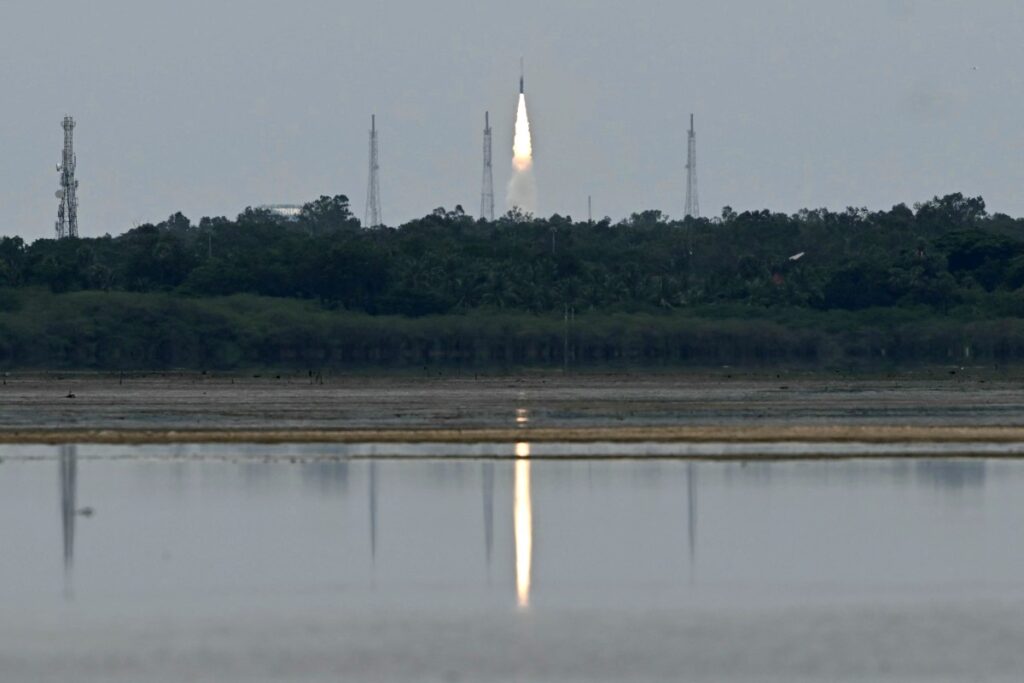
India has successfully launched its first privately developed orbital rocket, marking a historic breakthrough in the country’s rapidly expanding commercial space sector and reinforcing its ambition to become a major player in the global space economy.
The India private orbital rocket, known as Vikram-1, blasted off on Saturday from the Satish Dhawan Space Centre in Sriharikota. The successful maiden flight represents the first time an Indian private company has independently placed an orbital-class launch vehicle into flight, highlighting the country’s growing capabilities beyond its state-run space programme.
Developed by Hyderabad-based Skyroot Aerospace, Vikram-1 is designed to carry small satellites into low-Earth orbit and is expected to support the increasing global demand for affordable satellite launch services.
Following the launch, Skyroot Aerospace celebrated the achievement on social media.
“Hello space, we have arrived! Vikram-1’s Test Flight-1 has completed its mission. The first ever Indian private sector launch has been successfully completed,” the company posted on X.
A Landmark for India’s Private Space Industry
The successful mission marks a turning point for India’s commercial space ambitions.
Standing approximately as tall as a seven-storey building, Vikram-1 can carry payloads weighing up to 350 kilograms into low-Earth orbit, making it well suited for launching small satellites, scientific experiments and technology demonstrations.
The rocket carried a range of unique payloads on its inaugural mission, reflecting both scientific innovation and symbolic significance.
Among them were:
- A laboratory-grown diamond.
- Robotic arms designed to help remove space debris.
- A miniature 18-karat gold rocket featuring sculptures honouring three renowned Indian scientific figures—space programme pioneer Vikram Sarabhai, Nobel Prize-winning physicist C. V. Raman, and former President and aerospace scientist A. P. J. Abdul Kalam.
The successful deployment of these payloads demonstrates the growing sophistication of India’s emerging private aerospace sector.
Government Hails Historic Achievement
Indian Prime Minister Narendra Modi described the launch as a defining moment for the country’s space programme.
“The growing participation of our private sector is opening new frontiers and accelerating innovation,” Modi said.
He added that the achievement would inspire young Indians to pursue careers in science, technology and innovation.
Foreign Minister S. Jaishankar also congratulated the team behind the launch, declaring that India’s space ambitions were reaching new heights.
Meanwhile, Pawan Goenka, Chairman of the Indian National Space Promotion and Authorisation Centre (IN-SPACe), praised Skyroot Aerospace for exceeding expectations.
He said the success went “way beyond expectation for the very first orbital launch ever taken by an Indian private company.”
Private Sector Driving India’s Space Growth
India’s space industry has undergone significant transformation since the government opened the sector to private companies in 2020.
Previously dominated by the Indian Space Research Organisation (ISRO), the country’s space ecosystem now includes more than 400 startups working on launch vehicles, satellite technology, earth observation, communications and space applications.
The liberalisation has encouraged private investment, accelerated innovation and created new opportunities for commercial launches both domestically and internationally.
According to government estimates, India’s space economy is currently valued at approximately $8.4 billion, with officials aiming to substantially increase its contribution to the global commercial space market over the coming years.
Building on India’s Recent Space Successes
The Vikram-1 launch builds on a series of major achievements that have elevated India’s standing in global space exploration.
In August 2023, India became only the fourth nation to successfully land an unmanned spacecraft on the Moon after the Chandrayaan-3 mission touched down near the lunar south pole.
That accomplishment followed decades of investment in space science and engineering by ISRO, whose low-cost missions have earned international recognition.
Former ISRO Chairman K. Sivan said the successful orbital launch by Skyroot Aerospace demonstrates how government reforms are beginning to produce tangible results.
He described the launch vehicle as one of the most technically demanding systems in the aerospace industry and said its successful development would motivate other entrepreneurs and engineers.
READ MORE: India Asks Meta to Delay WhatsApp Username Feature Rollout
“There is no doubt,” Sivan told AFP, “that this launch will have a global impact.”
He added that if an Indian startup can successfully build one of the world’s most complex technologies, it significantly strengthens India’s reputation as an emerging global leader in space innovation.
Expanding India’s Role in the Global Space Economy
Industry analysts believe private launch providers like Skyroot Aerospace could help India capture a larger share of the fast-growing global market for launching small satellites.
Demand for cost-effective access to space continues to rise as governments, research institutions and private companies deploy constellations of satellites for communications, Earth observation, navigation and climate monitoring.
With Vikram-1 successfully completing its inaugural orbital mission, India has demonstrated that its private aerospace industry is capable of competing alongside established international launch providers.
The achievement is expected to encourage greater investment in India’s commercial space sector while strengthening the country’s long-term ambitions to become a leading destination for affordable and reliable space launches.