
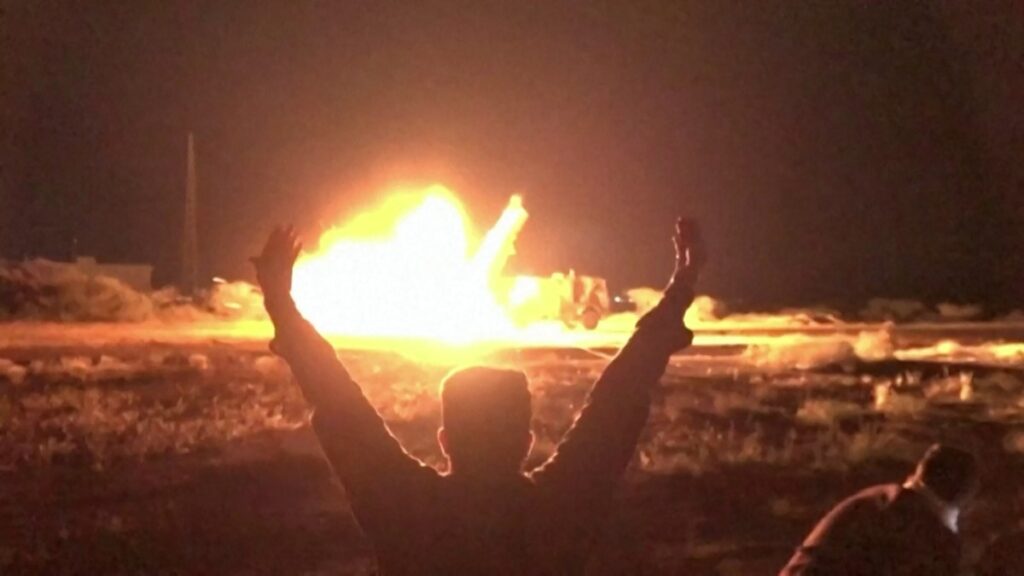
Iran said Wednesday that the United States launched fresh strikes on key southern ports, including the city of Bushehr, home to the country’s only civilian nuclear power plant, marking a dramatic escalation in renewed hostilities between Washington and Tehran.
The latest attacks come less than a month after both countries signed a memorandum of understanding aimed at ending the Middle East conflict that erupted in February. The fragile truce has now collapsed, with military operations resuming across the region.
According to Iranian state media, explosions were reported in Bandar Abbas, on Qeshm Island, Bandar Imam Khomeini and later in Bushehr. The strikes followed an announcement by the US military that it had targeted dozens of Iranian military sites near the Strait of Hormuz and along Iran’s southern coastline.
US Targets Military Infrastructure
The US Central Command (CENTCOM) said the operations were intended to reduce Iran’s ability to threaten commercial shipping and civilian vessels operating in one of the world’s busiest maritime corridors.
“US forces are holding Iran accountable for unwarranted aggression that continues to endanger innocent lives,” CENTCOM commander Admiral Brad Cooper said.
He accused Iran of deliberately targeting civilian shipping over the past week, claiming attacks on seven commercial vessels had left several crew members dead, injured or missing.
The renewed military campaign follows months of tensions surrounding the Strait of Hormuz, a strategic waterway through which roughly one-fifth of the world’s oil and liquefied natural gas supplies pass.
Iran Vows Strait of Hormuz Will Remain Closed
Iran’s Revolutionary Guards reiterated that the Strait of Hormuz would remain closed until the United States ends what Tehran describes as acts of aggression.
“The retaliatory operations of the fighters will continue, and the Strait of Hormuz will remain closed until the United States ends its acts of aggression,” the Guards said in a statement.
Iran initially blockaded the strategic waterway after large-scale US and Israeli attacks on February 28 before briefly reopening it during peace negotiations. Authorities later reinstated the closure after fighting resumed.
Deputy Foreign Minister Kazem Gharibabadi said Washington’s renewed naval blockade had effectively dismantled last month’s Islamabad memorandum, which had been designed to halt hostilities and create space for negotiations.
Despite the renewed violence, officials have indicated that diplomatic talks have not been formally abandoned.
Trump Warns of Broader Military Action
US President Donald Trump warned that the military campaign could intensify if Tehran refuses to return to negotiations.
“Next week it gets really bad for them,” Trump said during an interview with Fox News, adding that future operations could target Iranian power plants and bridges.
Trump also announced a policy shift regarding commercial shipping through the Strait of Hormuz. He withdrew an earlier proposal to impose a 20 percent fee on vessels using the waterway, saying it would instead be replaced by expanded trade and investment agreements with Gulf allies.
“I have decided to replace the 20% United States Reimbursement Fee with Trade and Investment Deals that the various Gulf States will be making into the United States,” Trump wrote on his Truth Social platform.
Regional Tensions Continue to Rise
The conflict is increasingly affecting neighbouring countries across the Gulf.
Iran’s Revolutionary Guards said they launched attacks against the US Fifth Fleet based in Bahrain, while Bahraini authorities reported intercepting attacks directed at civilian areas.
Jordan’s military said it intercepted three Iranian missiles that entered its airspace.
Kuwait also reported that one of its naval vessels was damaged during an Iranian missile and drone attack, leaving four crew members injured.
Meanwhile, a Norwegian oil tanker suffered damage from an explosion caused by an unidentified device off the coast of Oman, according to maritime security firm MTI Network, highlighting growing risks to commercial shipping in the region.
Civilian Life Shows Mixed Picture
Despite the renewed fighting, life continued relatively normally in parts of Iran.
AFP journalists reported that residents in Tehran gathered in cafés to watch the France-Spain FIFA World Cup semi-final, suggesting that daily life in the capital had not yet been significantly disrupted.
Elsewhere in the Gulf, however, anxiety continues to grow.
“Every day, I wake up wondering whether the situation will de-escalate or worsen,” said Mustafa Mohamed, a Sudanese accountant living in Kuwait.
“It has become difficult to feel at ease or plan anything because uncertainty grips everyone.”
George Atef, an Egyptian civil servant also based in Kuwait, said the prolonged uncertainty had become emotionally exhausting.
“What exhausts me most is not knowing when this situation will end — the waiting itself has become draining,” he said.
READ MORE: US Strikes Iran Again as Hormuz Blockade Threat Escalates
Casualties Mount
Iranian government spokeswoman Fatemeh Mohajerani said renewed US attacks since last week have killed at least 30 people.
Separately, the Iranian military confirmed that seven service members were killed during Wednesday’s strikes in southeastern Iran.
The growing casualty toll underscores the rapid deterioration of security following the collapse of last month’s ceasefire efforts.
Israel Issues Fresh Warning
Although Israel has not re-entered the conflict militarily, Prime Minister Benjamin Netanyahu warned Tehran against launching attacks on Israeli territory.
Speaking from Dimona, widely believed to be the location of Israel’s undeclared nuclear programme, Netanyahu warned Iranian leaders that Israel would respond forcefully if provoked.
“Do not count on things remaining quiet if you attack us,” he said.
The renewed confrontation between Iran and the United States has once again heightened fears of a broader regional conflict, threatening global energy supplies, maritime security and diplomatic efforts aimed at restoring stability in the Middle East.