
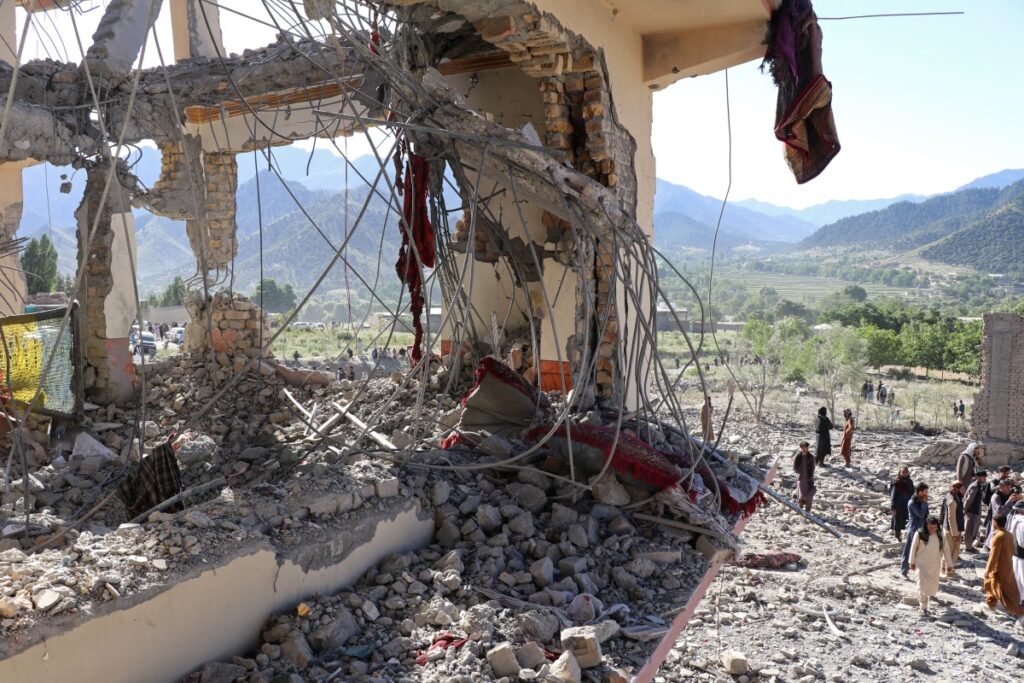
Pakistan has carried out fresh airstrikes in eastern Afghanistan, with Islamabad saying it targeted militant hideouts linked to a deadly attack in Karachi, while the Taliban-led Afghan government accused Pakistan of killing dozens of civilians in the latest escalation of tensions between the neighbouring countries.
The strikes, announced on Monday, underline the fragile security situation along the Afghanistan-Pakistan border despite a ceasefire agreed earlier this year. The latest violence also highlights the deep divisions between Islamabad and Kabul over the presence of militant groups operating near their shared frontier.
According to Pakistan’s government, the military operation targeted members of Jamaat-ul-Ahrar, a splinter faction of the Tehreek-i-Taliban Pakistan (TTP), which Islamabad blames for carrying out a deadly attack on a Rangers paramilitary camp in Karachi over the weekend.
Pakistan’s Information Minister Attaullah Tarar said the operation killed 25 militants, while four more were killed during separate ground operations conducted in border areas.
“Three targets in Paktia, Paktika and Kunar were destroyed during precision strikes,” Tarar said in a statement.
He added that the military operation included both aerial bombardments and coordinated ground assaults against suspected militant positions.
Afghanistan Reports Heavy Civilian Casualties
The Taliban government disputed Pakistan’s account of the operation, saying the strikes caused significant civilian casualties across three eastern provinces.
According to deputy government spokesman Hamdullah Fitrat, the airstrikes killed 36 civilians and wounded 163 others.
Fitrat also accused Pakistan of launching a second wave of attacks while local residents were attempting to rescue victims from the initial strikes.
“When local residents gathered to conduct rescue operations, the area was bombed for a second time,” he said, referring to attacks in Paktia province.
Afghan officials have consistently rejected Pakistan’s claims that militant groups use Afghan territory as a base to launch attacks across the border.
Karachi Attack Triggered Military Response
The latest operation follows one of the deadliest militant attacks in Karachi in recent years.
On Saturday, gunmen stormed a Rangers paramilitary camp after detonating explosives before opening fire inside the facility.
Pakistani authorities said three Rangers personnel were killed during the assault.
Officials also announced the arrest of an Afghan national believed to be among those involved in the attack, although further details about the investigation have not been made public.
Islamabad maintains that militant organisations linked to the TTP continue to plan and coordinate attacks from bases inside Afghanistan, an allegation repeatedly denied by Kabul.
Ceasefire Under Pressure
The airstrikes represent another setback for a ceasefire agreed between Pakistan and Afghanistan in March following weeks of intense fighting that erupted in late February.
Although the truce significantly reduced hostilities, sporadic clashes have continued along the border.
Afghan officials previously reported that Pakistani airstrikes in June killed at least 13 people.
The February conflict marked one of the most serious military confrontations between the two countries in decades.
According to the United Nations, hundreds of people were killed during weeks of fighting, while tens of thousands were displaced from communities along the border.
The conflict also saw unprecedented Pakistani airstrikes targeting Afghan cities, including the capital, Kabul, and the southern city of Kandahar, where the Taliban’s supreme leader is based.
Longstanding Security Dispute
Pakistan has long accused the Taliban-led Afghan government of failing to prevent militant groups from operating inside Afghanistan.
The primary concern for Islamabad is the Tehreek-i-Taliban Pakistan, which has intensified attacks against Pakistani security forces in recent years.
Pakistani officials insist that military operations are conducted using precise targeting to minimise civilian casualties while destroying militant hideouts and weapons depots.
The Afghan government, however, argues that Pakistan’s cross-border operations have repeatedly caused heavy civilian losses.
Kabul has previously cited attacks on civilian infrastructure, including a strike on a drug treatment centre in March that the United Nations said resulted in hundreds of deaths.
The opposing narratives have further strained diplomatic relations between the two neighbours.
Regional Mediation Efforts Continue
The renewed violence comes as Pakistan is simultaneously playing a diplomatic role in efforts to mediate between the United States and Iran over the conflict in the Middle East.
Despite those international engagements, Islamabad says it remains committed to pursuing military action against armed groups it considers a threat to national security.
Read More: Iran, Oman Hold First Hormuz Talks After US Peace Deal
Meanwhile, attempts by regional powers, including China, to broker a lasting settlement between Pakistan and Afghanistan have so far failed to produce a durable agreement.
Cross-border tensions have remained high since violence intensified in October, with much of the frontier remaining closed because of ongoing security concerns.
As both governments continue to exchange accusations over responsibility for the latest bloodshed, prospects for restoring stable relations remain uncertain, raising fears of further military escalation in one of South Asia’s most volatile border regions.
AFP