



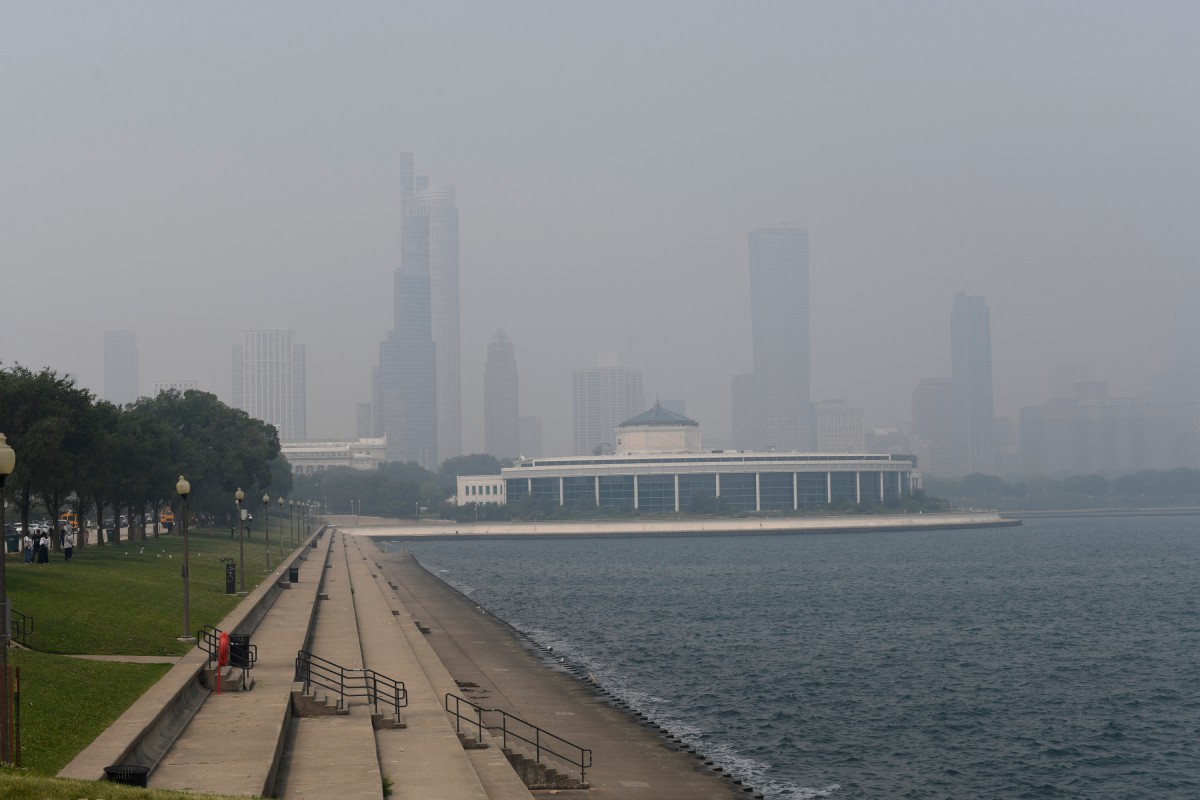
United States President Donald Trump has threatened to increase tariffs on Canadian imports, arguing that recurring wildfire smoke drifting south from Canada is imposing billions of dollars in economic and public health costs on the United States.

The remarks come as thick smoke from hundreds of active wildfires across Canada continues to blanket large parts of the US Midwest and Northeast, prompting widespread air quality alerts and raising concerns ahead of Sunday’s FIFA World Cup final in New Jersey.
In a post on his Truth Social platform on Friday, Trump accused Canada of failing to properly manage its forests and suggested that the financial burden of the smoke should be reflected in trade measures.
“This is Willful Negligence, and becoming a yearly occurrence, costing the United States Billions of Dollars,” Trump wrote.
He added that “the cost of this pollution must of necessity be added to the TARIFFS Canada is currently paying.”
Trump also claimed Canada was “not properly maintaining” its forests and had failed to carry out “basic Forest Management and Debris Removal.” He said he planned to speak with Canadian Prime Minister Mark Carney to discuss what Canada intended to do about the worsening smoke.
Canada Defends Wildfire Response
Canadian officials rejected suggestions that the country was neglecting its forests, emphasizing ongoing cooperation with the United States in responding to increasingly severe wildfire seasons.
Canada’s Minister of Emergency Management, Eleanor Olszewski, said both countries remained in “constant contact” and pointed to their long-standing partnership in fighting wildfires.
She added that Canada has invested approximately $12 billion in forest sustainability, wildfire prevention and resilience measures since 2020.
As of Saturday, the Canadian Wildland Fire Information System reported 937 active wildfires nationwide, with most burning out of control. Ontario remains among the hardest-hit provinces, where authorities have evacuated several remote communities while dozens of aircraft continue aerial firefighting operations.
Officials said no fatalities had been reported from the Ontario fires.
Smoke Triggers Air Quality Warnings Across US
The wildfire smoke has significantly degraded air quality across large sections of the United States.
According to air quality monitoring company IQAir, Detroit ranked as the world’s most polluted major city on Friday, while Washington, D.C., and Chicago also experienced dangerously poor air conditions.
Health authorities across affected states advised residents—particularly children, older adults and people with respiratory or heart conditions—to avoid prolonged outdoor activities.
In New York City, visibility deteriorated sharply on Thursday as smoke obscured parts of the Manhattan skyline. Although conditions improved slightly on Friday, the National Weather Service warned that smoke concentrations could increase again overnight into Saturday.
Libraries, train stations and other public facilities in New York distributed free protective face masks as residents sought relief from hazardous air pollution.
Communities across Michigan, Minnesota and Wisconsin have endured several consecutive days of air quality readings classified as “hazardous,” the highest level on the US Air Quality Index.
Meanwhile, the US Forest Service reported that 16 active wildfires were burning in Minnesota’s Superior National Forest near the Canadian border.
Firefighters face additional challenges from forecasts of erratic weather, shifting winds and isolated thunderstorms capable of spreading flames more rapidly.
World Cup Final Weather Under Close Watch
The poor air quality has also drawn attention from organisers of Sunday’s FIFA World Cup final, scheduled to take place in an open-air stadium in New Jersey.
Andrew Giuliani, executive director of the White House World Cup Task Force, said tournament organisers were closely monitoring air quality conditions ahead of the match.
Meteorologists say changing wind patterns over the Great Lakes could determine how much additional smoke reaches the northeastern United States during the weekend.
National Weather Service meteorologist Peter Mullinax told AFP that forecasts currently suggest conditions should improve before Sunday’s match, though some haze may remain.
“I don’t believe that this should be as impactful as if you might be playing a game today,” he said.
READ MORE: Israel Warns US of Iran Plot to Kill Trump, Reports Say
However, Joel Dreessen, an air quality forecaster for the state of Maryland, cautioned that forecast models indicate fresh smoke could drift south depending on evolving weather systems.
Health Experts Warn of Toxic Smoke Exposure
Medical experts continue to warn that wildfire smoke poses significant health risks.
Chris Carlsten, a researcher at the University of British Columbia who studies the health effects of wildfire smoke, said the fine particulate matter produced by forest fires primarily affects the lungs, although prolonged exposure can also impact overall health.
Unlike ordinary urban pollution, wildfire smoke can contain particles from burned vegetation as well as plastics, paint, metals and other synthetic materials consumed by the fires.
Carlsten explained that as smoke travels over long distances, it undergoes a process known as “photochemical aging,” during which sunlight and atmospheric reactions alter its chemical composition.
Those reactions, he said, appear to make airborne particles even more toxic.
Climate Change Fueling Longer Fire Seasons
Scientists say increasingly intense wildfire seasons are being driven by climate change.
Mark Parrington, a scientist with the Copernicus Atmosphere Monitoring Service, said higher temperatures and drier soils are creating ideal conditions for larger and longer-lasting wildfires.
According to Parrington, once fires ignite under these conditions, they can continue burning for weeks or even months throughout the summer.
The recurring episodes of cross-border smoke have renewed discussions about climate adaptation, forest management and international cooperation as both Canada and the United States confront increasingly severe wildfire seasons.
While Trump has linked the smoke crisis to trade policy, Canadian officials continue to stress that addressing extreme wildfire conditions requires coordinated emergency response and long-term investment in forest resilience.