
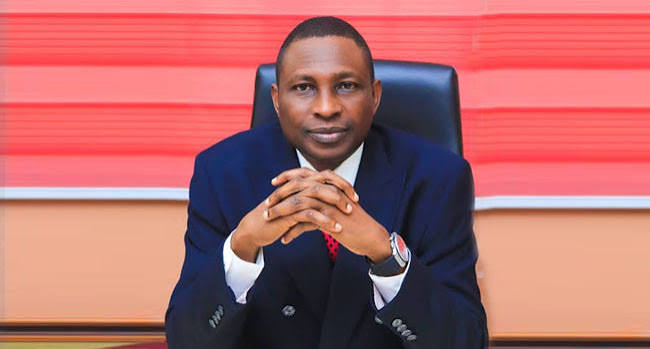
The Chairman of the Economic and Financial Crimes Commission, Ola Olukoyede, has disclosed that a university recovered through a forfeiture case has been converted into a federal institution serving thousands of students.

Olukoyede said the former NOK University in Kachia, Kaduna State, is now the Federal University of Applied Sciences, Kachia (FUASK), following its final forfeiture to the Federal Government.
According to the EFCC chairman, 1,909 students were matriculated at the institution in December 2025.
He said the development demonstrated how assets recovered from criminal activities could be redirected towards productive uses that benefit society.
Olukoyede said the university was expected to generate wider economic benefits for its host community and the Southern Kaduna region.
Beyond providing access to higher education, he said the institution could contribute to local economic activity and create opportunities for young people in the area.
The EFCC chairman described the transformation as an example of how asset recovery can move beyond simply taking property from convicted or investigated individuals.
Olukoyede also disclosed that another privately owned university had recently been finally forfeited to the Federal Government.
Although he did not name the institution in his social media post, his description appeared to correspond with Rayhaan University in Kebbi State.
The university’s permanent and temporary sites, among other properties, were covered by a forfeiture order secured by the EFCC in July 2026.
Olukoyede drew particular attention to the residence reportedly constructed for the university’s vice-chancellor, describing its size as exceptionally large.
The EFCC chairman said the Commission’s recovery activities between October 2023 and July 2026 extended far beyond universities.
According to him, the agency secured forfeiture of 10,053 assets during the period.
The assets included land, buildings, vehicles, electronics, schools, factories, hotels, machinery, aircraft, oil rigs and barges.
He also disclosed that about 102 tonnes of solid minerals were recovered through the Commission’s enforcement activities.
Olukoyede said the disposal of some recovered assets had so far generated ₦12.07 billion for the Federal Government.
He argued that the economic value of asset recovery should not be measured solely by cash recovered.
According to him, removing assets allegedly acquired through criminal enterprises can strengthen government revenue, protect the integrity of financial markets and discourage further economic crimes.
The latest disclosure forms part of the EFCC’s broader performance report under Olukoyede.
READ MORE: Dangote Refinery IPO To Open In 10 To 12 Days — Aliko Dangote
The Commission has reported recovering ₦1.233 trillion in naira, in addition to funds recovered in foreign currencies, between October 2023 and July 2026.
The agency also reported securing 10,872 convictions during the same period.
Olukoyede said the figures reflected an approach to enforcement focused not only on punishment but also on ensuring that recovered assets ultimately provide value to the Nigerian public.
The EFCC chairman said the conversion of forfeited assets into useful public institutions demonstrates how proceeds recovered from alleged criminal activity can be redirected towards education and economic development.
The development also raises the profile of asset forfeiture as a tool for recovering public value and ensuring that properties linked to criminal proceeds can eventually serve broader societal purposes.