


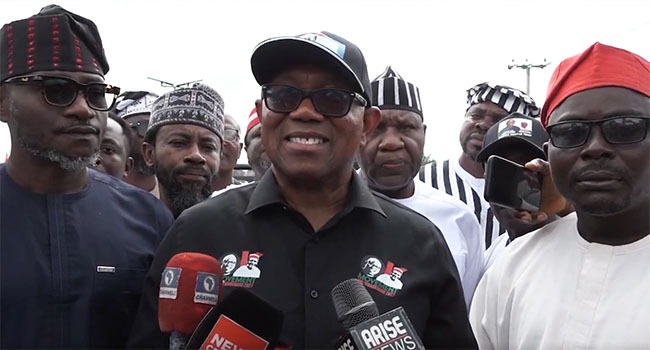
The presidential candidate of the National Democratic Congress (NDC), Peter Obi, was prevented from reaching Yelwata community in Guma Local Government Area of Benue State on Tuesday, after youths blocked his convoy as he attempted to visit victims of deadly attacks in the area.

Obi had travelled to Benue to commiserate with residents affected by attacks by armed invaders, but his convoy was stopped along the Gboko Road near the Nigerian Air Force Base in Makurdi.
The incident marks the second time Obi has been prevented from entering Benue for a planned visit, following the cancellation of his proposed visit to internally displaced persons’ camps in the state in April 2025.
Obi and members of his entourage arrived in Makurdi on Tuesday morning but encountered a group of youths who had reportedly barricaded the road.
Witnesses said some of the youths were carrying sticks, while others allegedly threw stones at the convoy and spread across the road to prevent it from proceeding.
Denen Terkaa, a witness, said the youths stopped the convoy as it attempted to enter Makurdi after Obi arrived at the airport.
The Benue South Zonal Chairman of the NDC, Abu Suleiman, who was part of the entourage, confirmed the incident.
According to Suleiman, Obi attempted to engage the youths but they refused to allow him to proceed.
He said the convoy waited for more than an hour before Obi eventually turned back and flew to Jos, Plateau State.
Suleiman described the incident as “worrisome and barbaric”, questioning why Obi was prevented from visiting communities affected by attacks.
The Benue State Police Command confirmed that it was aware of the incident and had provided security for Obi’s movement.
The Police Public Relations Officer, DSP Orchia Peter Aondongu, said the command was monitoring the situation and investigating the circumstances surrounding the blockade.
He said the reason the youths prevented the convoy from proceeding remained unknown.
“We are monitoring the situation and investigating the circumstances surrounding the incident. Further updates will be provided accordingly,” the police spokesperson said.
The state Commissioner of Police, Cletus Nwadiogbu, later confirmed that youths had barricaded the roads because they did not want to see a particular high-profile individual.
Nwadiogbu said police had received information about Obi’s planned visit and deployed security personnel to accompany him.
He said the command would investigate why the youths decided to prevent the former Anambra governor from moving into the area.
The Benue State Government offered a different explanation for the incident.
The Commissioner for Information and Orientation, Solomon Iorpev, said Obi should have formally notified the state government about his visit so that adequate security arrangements could be made.
Iorpev said the government had a responsibility to protect a former governor visiting the state but argued that it could not guarantee his safety without prior notification.
“This is not the first time he has done this. He is just looking for our trouble. We are peace-loving and hospitable people,” the commissioner said.
He also explained that a meeting involving youths from the state’s 23 local government areas was scheduled around the period of Obi’s visit.
The commissioner, however, said he did not know the specific youths who blocked the road.
Speaking to supporters before leaving Benue for Jos, Obi said he had travelled to the state to sympathise with communities affected by killings rather than campaign.
The NDC candidate condemned the incident and questioned why people seeking to visit victims of violence would be prevented from doing so.
Obi said he had remained at the scene for some time hoping the youths would reconsider their action but eventually decided to leave to prevent further escalation.
He described the incident as unacceptable and called for a country where citizens could move freely and live in peace and security.
The former Anambra governor also appealed to Nigerians to participate actively in efforts to determine the country’s political future.
He promised to return to Benue if the need arose.
The NDC condemned the obstruction, describing it as “shameful” and “deeply troubling”.
The party said Obi’s purpose was to mourn with families who had lost loved ones, show solidarity with affected residents and hear directly from victims about measures needed to prevent further attacks.
The Peter Obi Media Office also alleged that the group that blocked the convoy consisted of “hired thugs”.
According to the media team, the mob carried sticks, clubs and stones and chanted for Obi to leave.
The group alleged that an aide to the state governor led the protesters, although the state government has not accepted responsibility for the blockade.
The media office said the presence of police officers did not prevent the crowd from breaching security arrangements, eventually forcing Obi’s convoy to make a U-turn.
Obi’s running mate, Rabiu Kwankwaso, condemned the incident and called on President Bola Tinubu to caution state governors against actions that could undermine democratic participation.
Kwankwaso described the attack on Obi’s convoy as disturbing and urged the Benue State Government to identify and prosecute those responsible.
He also argued that the constitutional right to freedom of movement should apply to Obi as a former governor and presidential candidate.
The former Kano governor called for adequate protection for Obi and his entourage during future movements.
He also urged the international community, diplomatic missions and election observation organisations to take note of the incident and encourage Nigerian authorities to protect opposition politicians and uphold the rule of law.
The incident has generated speculation about the political implications of Obi’s presence in Benue ahead of the 2027 presidential election.
In the 2023 presidential election, Bola Tinubu secured 310,468 votes in Benue, while Obi polled 308,099 votes, leaving a difference of just over 2,000 votes.
Obi’s strong showing in the state has made Benue an important battleground for the forthcoming presidential election.
Political observers have also linked the situation to the internal political dynamics within Benue, particularly tensions involving Governor Hyacinth Alia and Secretary to the Government of the Federation George Akume.
The state government, however, has rejected suggestions that political considerations were behind the obstruction.
Civil society organisations have also criticised the blockade while acknowledging the need for proper security planning around visits by high-profile political figures.
Comrade Debo Adeniran of the Committee for the Defence of Human Rights said Obi has constitutional rights to freedom of movement, peaceful assembly and political association.
He stressed that notifying security agencies about a planned visit should not be confused with obtaining government permission to exercise political rights.
Adeniran said advance notification could help security and traffic officials prepare for large gatherings and minimise disruption to other residents.
READ MORE: Tinubu: Nigeria Needs Leaders Driven By Public Good, Not Personal Interests
Ibrahim Yusuf, Chairman of the Gombe Network of Civil Society Organisations, also warned that incidents of this nature could increase political tensions ahead of the 2027 elections.
Yusuf urged opposition politicians to comply with legitimate security arrangements while cautioning government authorities against using notification requirements to intimidate or obstruct political opponents.
The confrontation in Benue comes as political parties intensify preparations for the 2027 general elections.
With Obi and other opposition figures seeking to consolidate support across the country, states where the 2023 election produced close contests are likely to attract greater political attention.
The incident has also renewed debate over the balance between security coordination, freedom of movement and political activity during the pre-election period.
For now, the police have said investigations are ongoing to determine why the youths blocked Obi’s convoy and whether anyone should be held responsible for the disruption.