



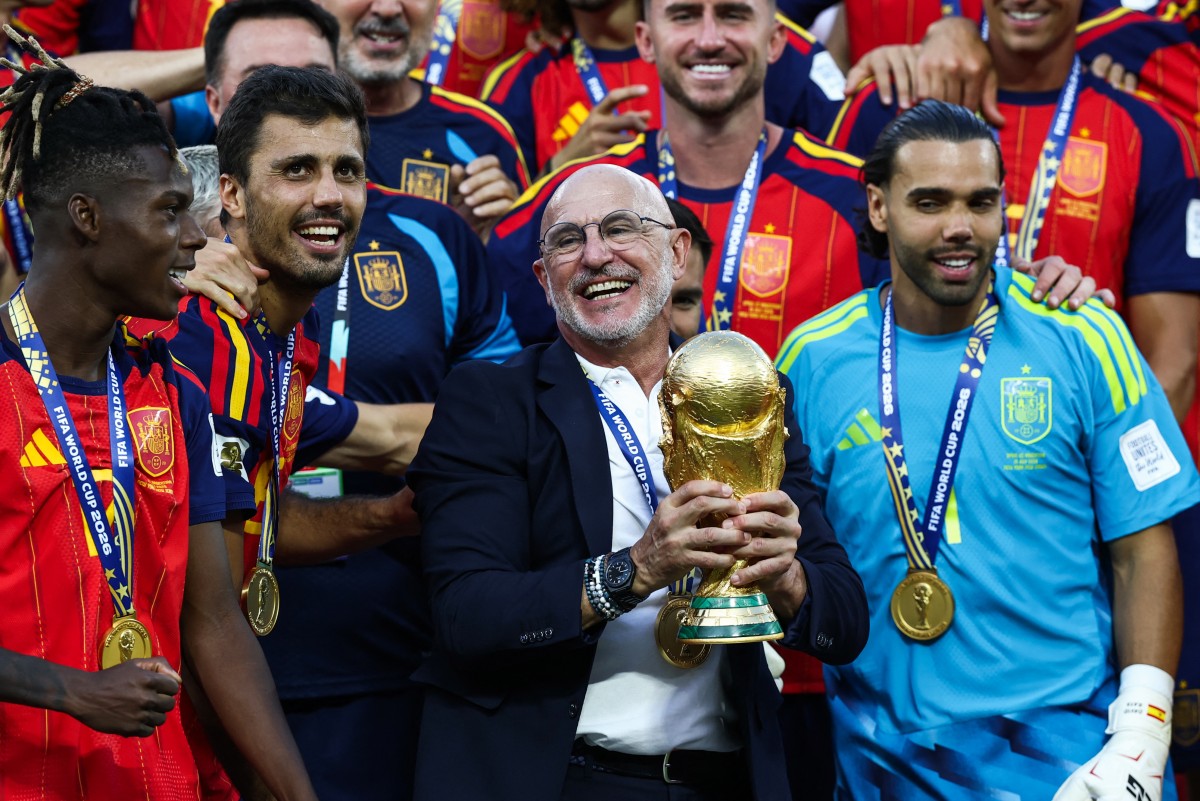
Spain’s World Cup champions are returning home to a hero’s welcome in Madrid after securing a dramatic 1-0 victory over Argentina in the FIFA World Cup final, capping off one of the country’s greatest periods in football history.

The national team, led by coach Luis de la Fuente, is expected to receive a reception befitting world champions, with around one million supporters anticipated to line the streets of the Spanish capital for a victory parade celebrating the country’s second men’s World Cup title.
The squad is scheduled to arrive in Madrid shortly before midday after defeating defending champions Argentina in Sunday’s final in East Rutherford, New Jersey. Their victory has sparked nationwide celebrations, rekindling memories of Spain’s historic triumph at the 2010 FIFA World Cup in South Africa.
For many younger Spanish supporters, this marks the first time they have witnessed the men’s national team lift football’s biggest prize, ending a 16-year wait since Andrés Iniesta’s famous extra-time winner secured Spain’s first World Cup crown.
The latest triumph further cements Spain’s status as one of world football’s dominant nations. It comes just two years after the country’s UEFA Euro 2024 success and follows the Spanish women’s national team’s FIFA Women’s World Cup victory in 2023.
Together, these achievements have highlighted the strength of Spanish football across both the men’s and women’s games, reflecting years of investment in youth development, coaching, and technical football.
Sunday’s final proved to be a tense contest as Argentina frustrated Spain for long periods before the decisive goal secured the championship.
The victory immediately triggered celebrations across Spain, with thousands of supporters gathering in public squares, bars and specially designated fan zones to watch the final before flooding streets in celebration at the final whistle.
Following their arrival, Spain’s World Cup champions are expected to be received by King Felipe VI and Prime Minister Pedro Sánchez before boarding an open-top bus for a parade through central Madrid.
The parade is expected to begin from the vicinity of the Moncloa Palace, the official residence of the Spanish Prime Minister, before making its way to the iconic Cibeles Square, long regarded as the symbolic home of Spanish football celebrations.
Authorities estimate that nearly one million fans could attend the event, prompting extensive security and transport arrangements across the capital.
Officials have deployed approximately 2,050 National Police officers alongside 400 Civil Guard personnel to maintain public safety and manage the expected crowds.
Although final timings remained subject to official confirmation, government officials indicated that celebrations would proceed throughout the afternoon following the team’s official receptions.
The royal household had yet to confirm whether King Felipe VI would personally attend the public festivities.
Scenes of celebration unfolded across Spain immediately after the final whistle.
In Madrid, thousands of supporters packed Colon Square, where one of several giant public viewing areas had been established for the final.
Fans draped in Spain’s red-and-yellow national flag sang, danced and celebrated well into the night, while fireworks illuminated the skyline and vehicle horns echoed throughout the capital.
Supporters repeatedly chanted “Campeones, Campeones” as flares and fireworks added to the festive atmosphere.
Elsewhere across Spain, celebrations spread rapidly from major cities to smaller towns and villages, with football supporters marking what many described as a historic sporting achievement.
The jubilant scenes closely resembled the nationwide celebrations that followed Spain’s maiden World Cup victory in 2010, when hundreds of thousands filled Madrid’s streets to welcome the victorious squad home.
The nationwide celebrations were, however, overshadowed by a tragic incident in the western town of Ciudad Rodrigo.
Local authorities confirmed that a 13-year-old boy died after a decorative fountain collapsed beneath the weight of supporters who had climbed onto the structure during celebrations.
Another young person was injured in the incident.
In a statement, the municipality expressed its condolences, saying what should have been a joyful celebration had instead ended in tragedy.
The incident cast a sombre note over an otherwise jubilant national occasion and prompted renewed calls for caution during large public gatherings.
Spain’s latest World Cup triumph represents another landmark achievement for a football nation renowned for its technical excellence and sustained success on the international stage.
Since transforming world football between 2008 and 2012 with consecutive European Championship victories and the 2010 FIFA World Cup title, Spain has rebuilt another generation capable of competing at the highest level.
Under Luis de la Fuente, that new generation has now delivered the country’s second men’s World Cup trophy, further strengthening Spain’s football legacy.
As millions prepare to celebrate in Madrid, the victory will be remembered not only as another World Cup success but also as a defining chapter in one of the most successful eras in Spanish football history.
AFP